


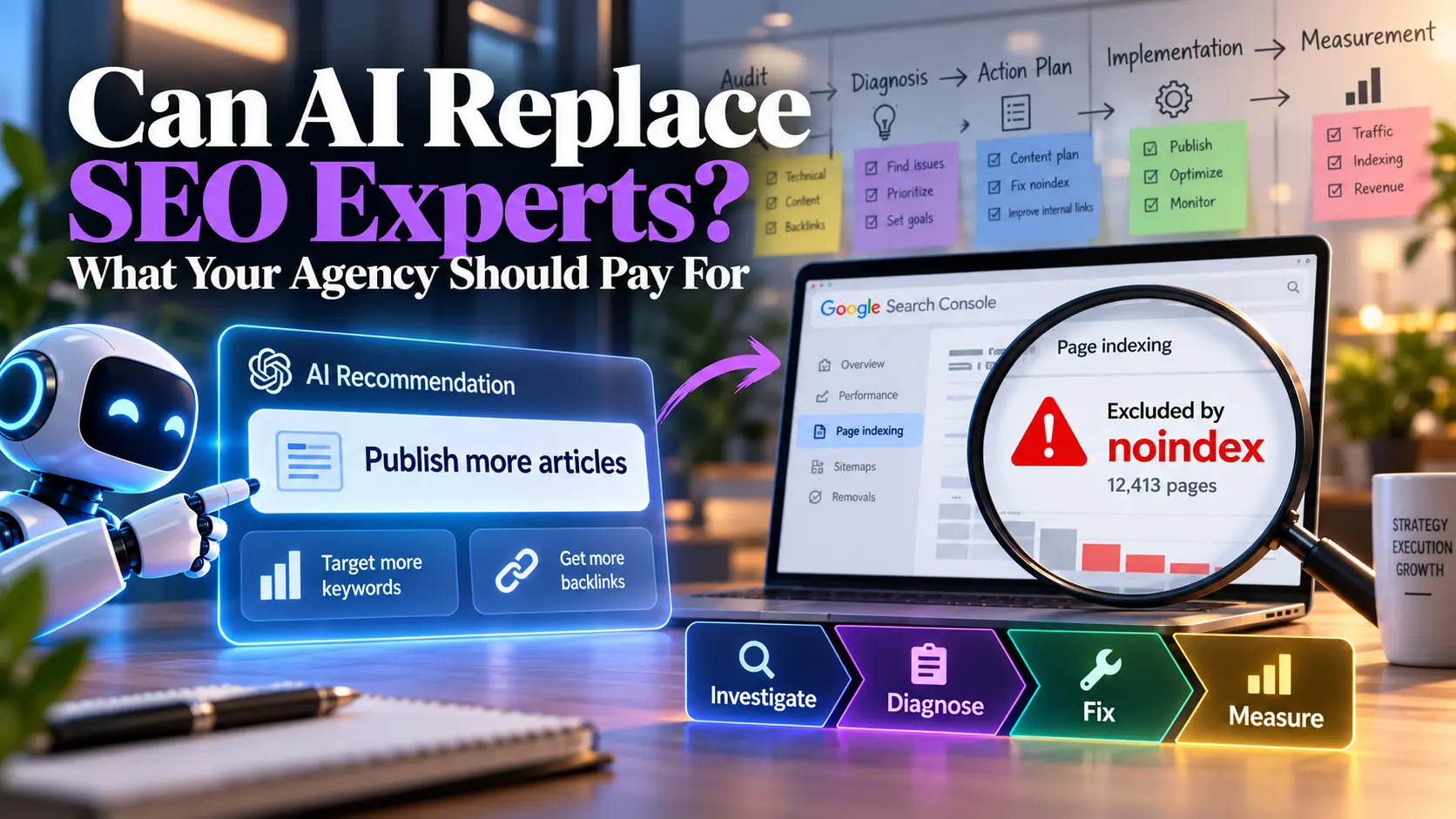
AI can help produce an SEO plan. The business decision is whether that plan addresses the right problem, can be implemented properly and deserves your investment.
Key Takeaways
- AI assists, humans verify: AI can support substantial SEO work, while the recommendations still need appropriate data, verification and business context.
- Strategic clarity over volume: An SEO consultant should provide clear diagnosis, priorities, implementation guidance and a way to evaluate progress.
- Outcomes over deliverables: Your agency should assess expertise through the quality of decisions and follow-through, rather than the number of documents delivered.
Can AI replace SEO experts?
AI can replace or assist with individual SEO tasks. Whether it can replace the support your agency needs depends on the work involved, the information available and the knowledge of the person supervising it.
Generating a content brief, reviewing a website problem and deciding how to spend an agency’s SEO budget involve different responsibilities.
A tool may contribute to all three. Your business still needs a reliable process for establishing facts, approving recommendations, implementing changes and reviewing what happened.
That responsibility could sit with a capable internal team or an external consultant. Hiring someone simply because they describe themselves as an expert does not resolve it.
The useful question is: what decisions and responsibilities are you paying that person to handle?
What AI can help your agency do
If you use AI for keyword ideas, article drafts or reporting, you already have a reasonable reason to question the value of repetitive SEO deliverables.
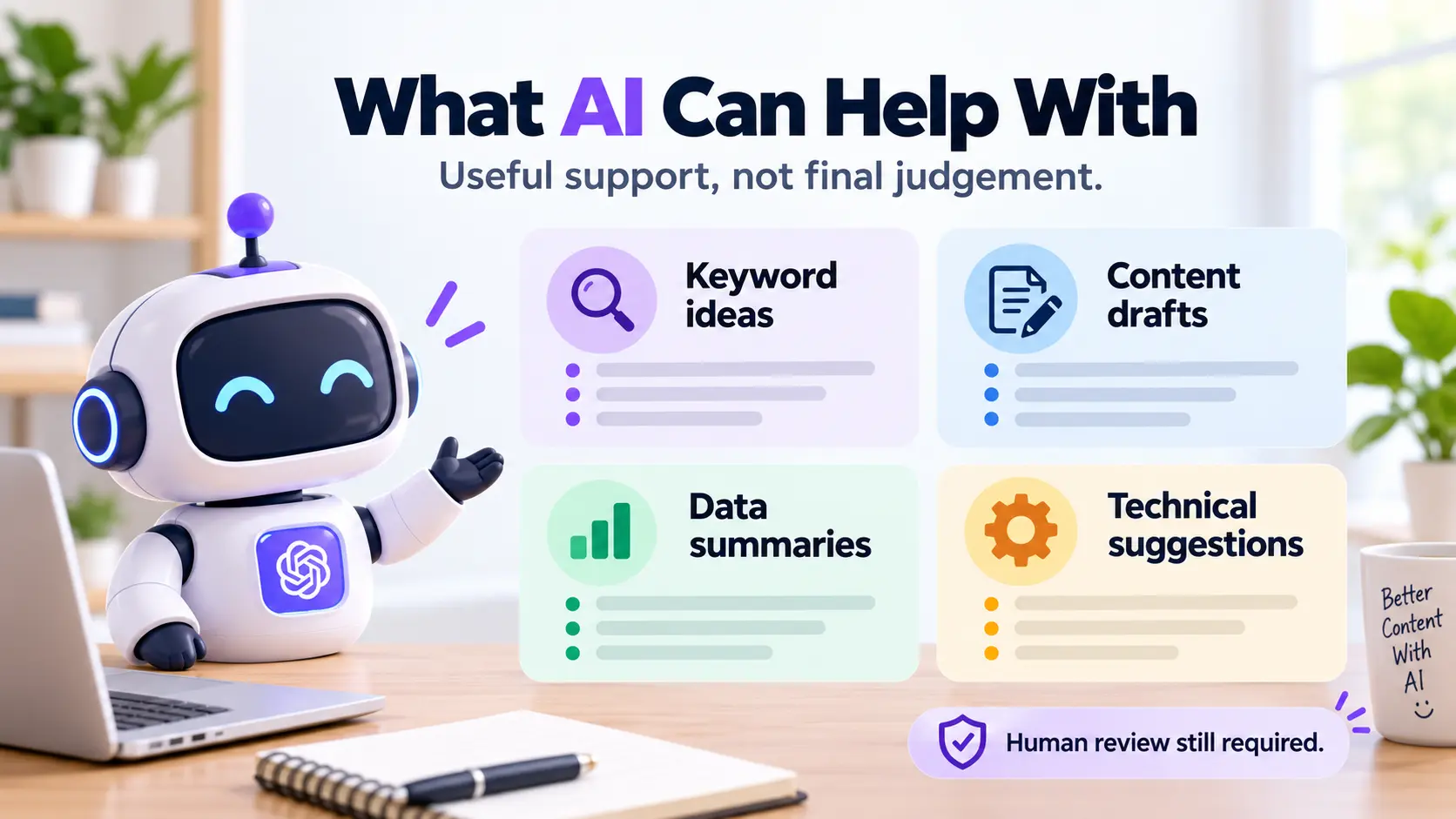
Depending on its setup and access to information, AI can help with:
- Organising keyword ideas and related questions.
- Preparing content outlines and first drafts.
- Summarising website and search-performance data.
- Suggesting possible explanations for an observed problem.
- Drafting technical recommendations and implementation notes.
These outputs can save work. They also need to be assessed according to the job they are meant to perform.
A keyword list needs validation. A draft needs accurate service information. A technical recommendation needs to fit the actual website.
The distinction becomes especially important when a polished document makes an incomplete investigation look finished.
Your agency should be able to ask how a recommendation was reached and what supports it, regardless of which tools helped produce it.
Where human expertise adds practical value
Understanding which business problem SEO should address
“Get more traffic” does not explain which clients your agency wants to attract.
An agency seeking landlord instructions has a different priority from one seeking more tenant enquiries. Both audiences may search for information about the same locations, but they need different services and next steps.
A useful investigation connects search behaviour with your services, intended clients and commercial priorities.
I would want to understand which enquiries matter, which properties and locations your team handles, and what happens after someone contacts you.
That context helps determine whether the priority is a service page, clearer information, a technical correction or an improvement to the enquiry process.
Separating an observation from a diagnosis
A page receiving few visits is an observation. It does not identify the cause.
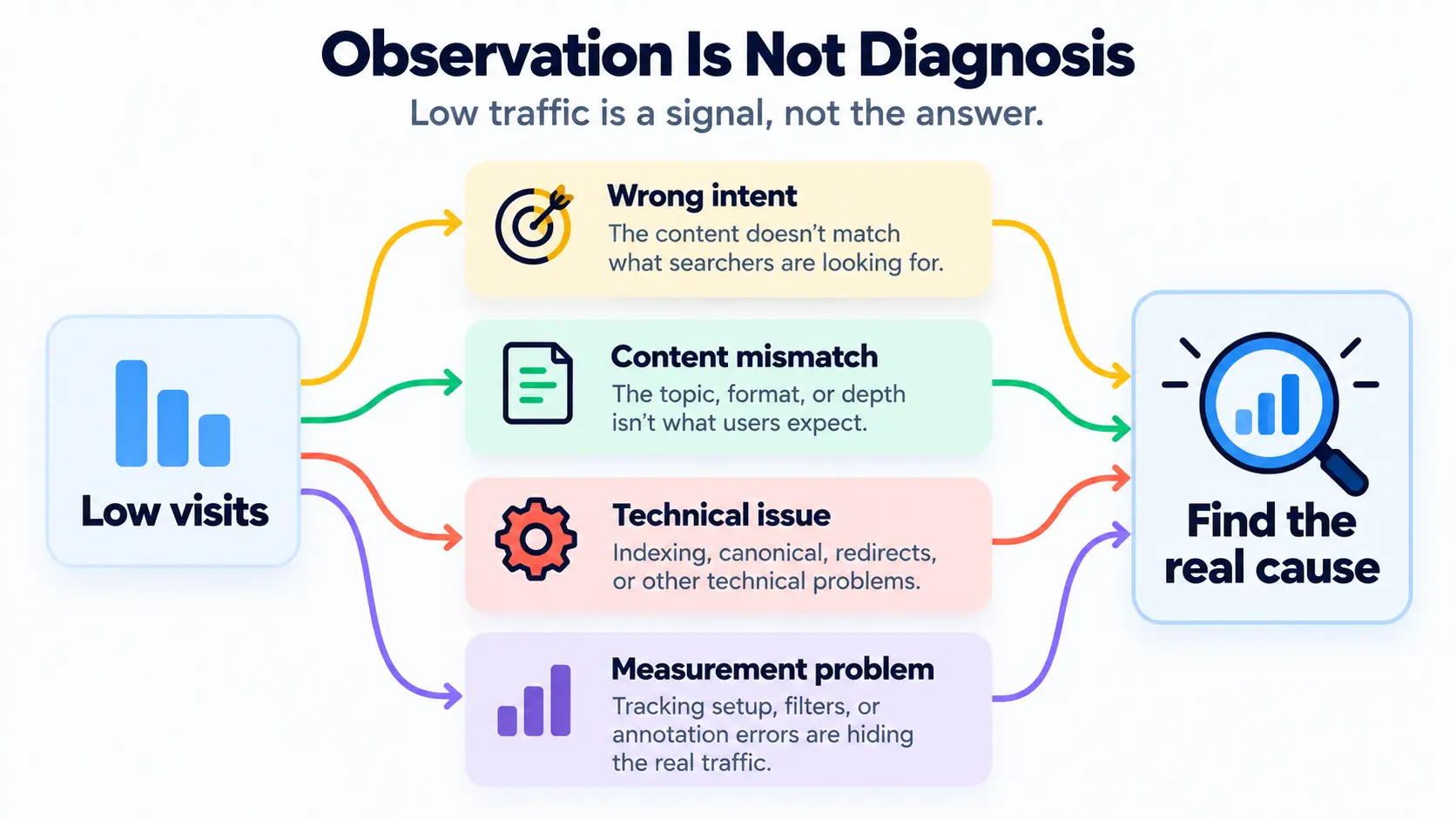
The page might address the wrong question, overlap with another page, be difficult to discover or contain information that does not meet the intended reader’s needs.
There may also be a measurement problem.
An experienced reviewer should investigate the relevant possibilities before recommending a solution. AI can help organise the investigation, but the supporting evidence still needs to be examined.
This is where human judgment in SEO should become visible: through questions, checks and explanations that connect a finding with an appropriate action.
Choosing priorities that fit your resources
Even a valid recommendation may be the wrong task to start with.
Your team has limited time, budget and development capacity. A priority should account for the importance of the affected page, the evidence available, the work required and any dependencies.
For example, correcting an inaccurate service claim may deserve immediate attention. A change affecting every page template may require testing and developer involvement. A minor formatting issue may reasonably wait.
A consultant should explain these trade-offs clearly enough for you to make an informed decision.
A longer task list should not automatically create a larger commitment.
Bringing accurate business knowledge into the content
An article can read well while misrepresenting your agency.
It may describe services you do not provide, imply coverage beyond your operating area or explain a process your team does not follow.
Useful content therefore needs input from people who know the business. Someone must confirm the facts, identify relevant expertise and approve claims before publication.
AI can help organise that information and improve its presentation. The agency and its content process still need to establish what is true.
This is also how your website can communicate something more useful than a general explanation available elsewhere.
Following the work through to evaluation
Recommendations need an agreed route into the live website.
Someone should define the change, coordinate the people involved, check the implementation and establish what will be reviewed afterwards.
For your agency, that review should consider whether the intended audience is finding relevant pages and making suitable enquiries.
More visits alone do not establish that the commercial objective has been met.
Enquiry handling matters too. Slow responses, unclear responsibilities or a service mismatch can affect outcomes even when website visibility improves.
How the difference works in a business situation
Consider a hypothetical real estate agency that wants more property owners to enquire about its lettings service.
Its website already contains property listings and community articles. The team receives a recommendation to publish more articles because organic enquiries are weak.
Further investigation finds that an important lettings-service page is being excluded from search because of a website setting.
Publishing additional articles would leave that particular problem unresolved.
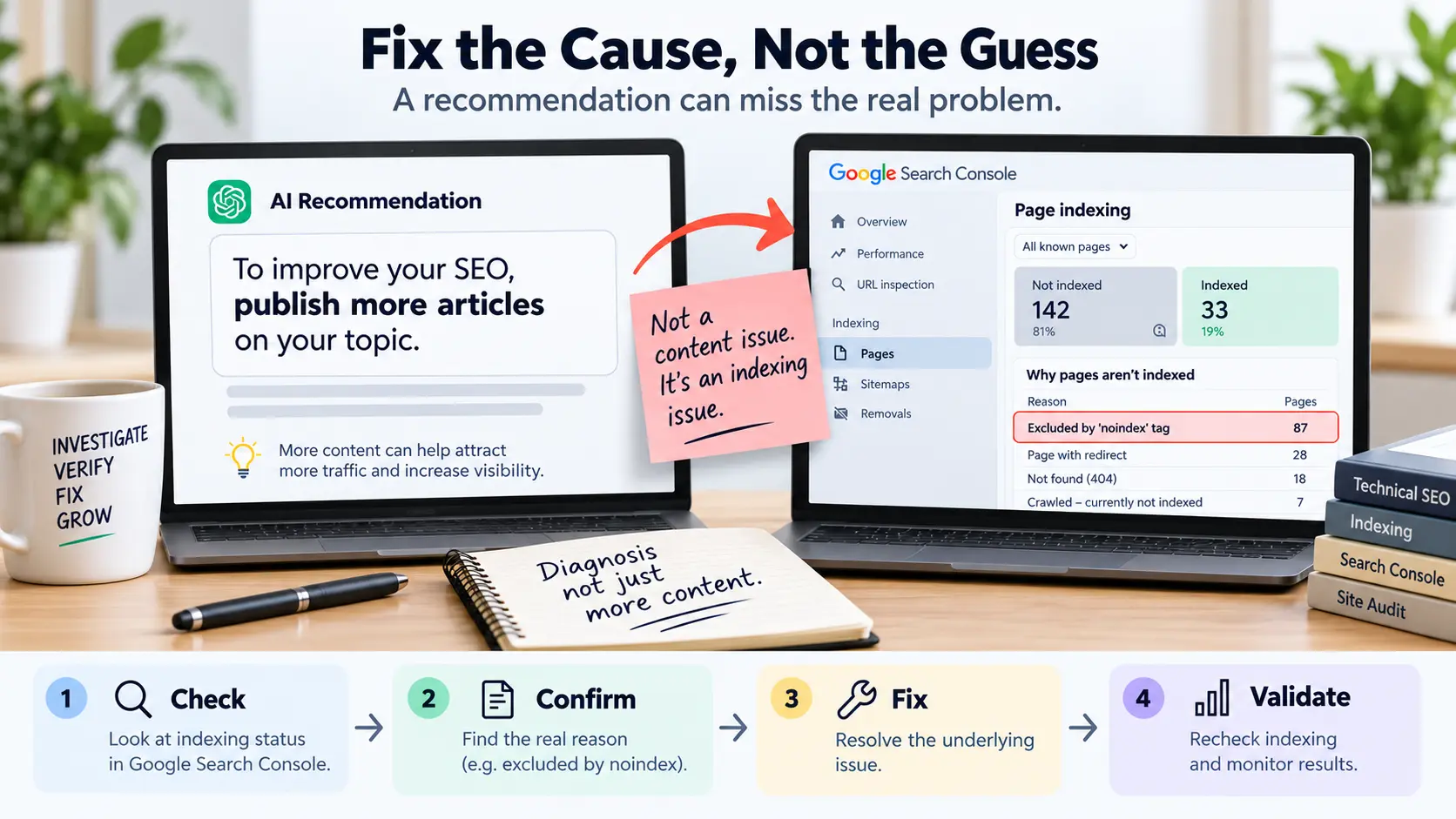
A sensible response would be to:
- Confirm whether the exclusion is intentional.
- Identify where the setting originates.
- Agree and implement an appropriate correction.
- Check the affected page afterwards.
- Continue investigating any remaining visibility problems.
An AI tool could help identify the issue. The example does not establish that only a human could find it.
It shows why your agency needs a process that connects evidence, diagnosis, action and verification before committing to more production.
What your agency should expect from an SEO consultant
An SEO engagement should make the next decision clearer.
I would assess the proposed work through five questions:
What evidence supports the recommendation?
Ask which pages, observations and checks led to the finding. A possible cause should be described as a possibility until it has been investigated.
Which business priority does it support?
You should understand which service, audience or enquiry need the work addresses.
Why should it happen now?
The priority should account for likely importance, effort, dependencies and available resources.
Who will implement and approve it?
Consulting, development and content production may be separate services. Agree on responsibilities and scope before assuming everything is included.
How will progress be reviewed?
Define what will be checked after implementation, which information is available and what the measurements cannot establish.
These questions make an AI-generated plan easier to evaluate. They also make a human consultant’s work easier to assess.
As an SEO Consultant in UAE, I start with the business priority and the website evidence available. My aim is to establish which decisions need attention before recommending more content or a broader programme of work.
My SEO consulting services explain how diagnosis, priorities and implementation guidance can fit into an agreed engagement.
When specialist help is worthwhile
Your agency may be able to manage a focused workflow internally when someone has the knowledge and time to verify the work.
Specialist input becomes more useful when the cause is unclear, important pages are affected, recommendations compete for resources or several people must coordinate changes.
An ongoing retainer is not automatically the appropriate starting point. A focused investigation, implementation review or training may better match the immediate need.
Before changing your SEO budget, choose one current recommendation and ask:
What problem does this solve, what evidence supports it, who owns the work, and how will its effect be reviewed?
The quality of those answers gives you something concrete to evaluate.