

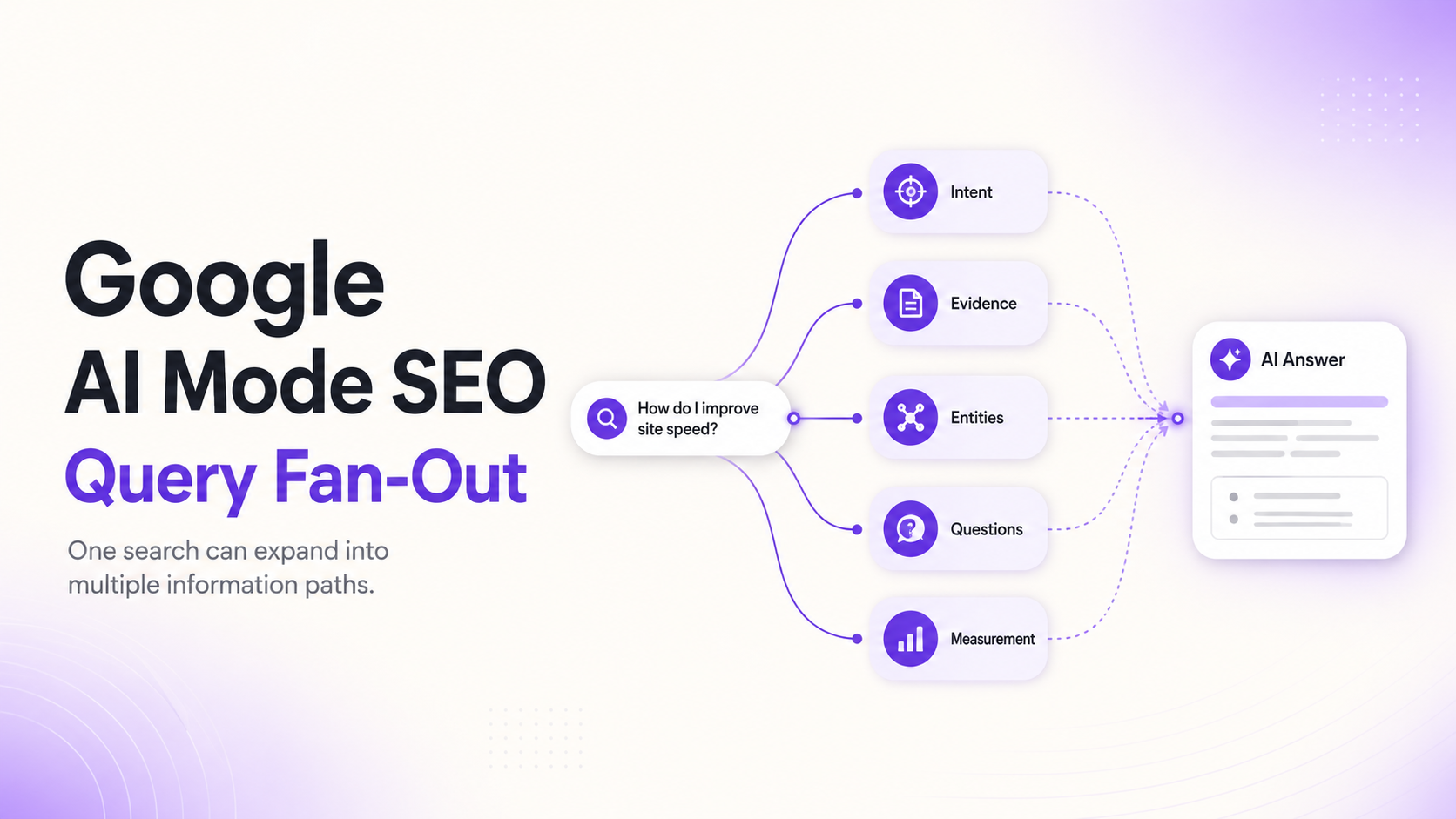
Google AI Mode changes how a search can be researched and answered, but it does not make SEO irrelevant.
The important change is query fan-out. Instead of relying only on the exact question someone types, Google’s generative search systems can generate multiple related searches, retrieve useful information across those subtopics and use the results to build a broader response.
That changes the content-planning question.
Instead of asking only: “Which keyword should this page rank for?” you also need to ask: “What information would Google need to retrieve to answer the searcher’s complete question?”
Google confirms that AI Mode and AI Overviews may use query fan-out and that its generative AI search features remain rooted in Google’s core Search ranking and quality systems. Google also says there are no special technical requirements or secret AI markup required simply to appear in these experiences.
The opportunity is significant. In May 2026, Google said AI Mode had passed one billion monthly users globally and that AI Mode queries had more than doubled every quarter since launch.
So the practical challenge for businesses is not to replace SEO with another acronym. It is to adapt SEO to a search experience that can explore a topic more deeply before presenting an answer.
What Is Query Fan-Out in Google AI Mode?
Query fan-out is a retrieval technique in which Google’s AI systems generate multiple related queries from the original search so they can collect additional information needed to answer it.
Google describes it as a set of concurrent related queries generated by the model to retrieve additional relevant search results. Both AI Mode and AI Overviews may use the technique.
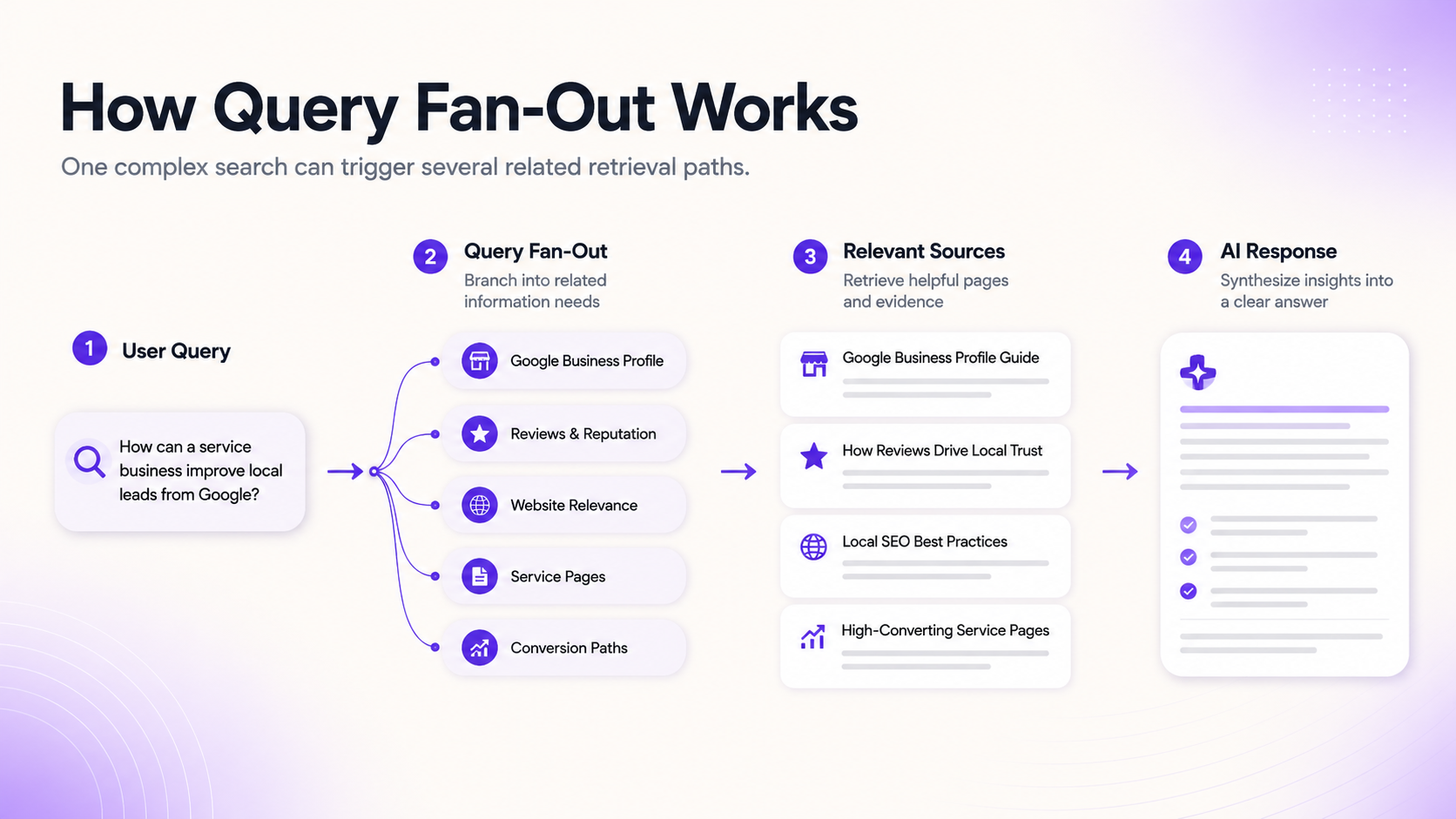
Consider this search: “How can a service business improve local leads from Google?”
A useful answer may require information about several different areas: Google Business Profile, local website relevance, reviews, service pages, location relevance, technical accessibility, and conversion paths.
The searcher did not type seven separate searches. A fan-out system can explore related aspects of the original problem and retrieve supporting information before producing its answer. That is why AI search creates a different content challenge from targeting a single exact-match keyword.
Do we know exactly what Google searches during fan-out?
No. Google explains the technique, but it does not publish the exact fan-out queries generated for every search or a universal number of searches that AI Mode always runs.
You may see claims that AI Mode always generates a specific number of hidden queries. Treat those numbers carefully unless they are clearly described as observations from a particular experiment or tool. The safe conclusion from Google’s documentation is simpler: one user query can lead to multiple related retrieval queries.
Does Google AI Mode Require a New Type of SEO?
No. Google explicitly says SEO remains relevant to its generative AI search features. Google’s 2026 guidance says these experiences are rooted in its core Search ranking and quality systems.
That means the foundations still matter: Google must be able to crawl the page, the page needs to be indexable, it must be eligible to appear in Search with a snippet, the content needs to satisfy a real user need, important information should be available in textual form, internal links should make important content discoverable, and structured data should match what users can actually see.
Google also states that no additional technical requirement exists specifically for AI Mode or AI Overviews.
Where do AEO and GEO fit?
AEO — Answer Engine Optimisation — and GEO — Generative Engine Optimisation — can be useful industry labels for discussing particular visibility problems. But Google’s own position is straightforward: from Google’s perspective, optimising for generative AI Search remains part of optimising the search experience, and therefore part of SEO.
Traditional SEO may ask: Can the page be discovered and ranked for relevant searches? AEO may add: Can a clear answer be extracted from the page? GEO may add: Does the content provide information and evidence that a generative system can use when synthesising an answer?
How Query Fan-Out Changes Keyword Research
Query fan-out does not make keyword research obsolete. It changes what you do after identifying the main query and intent.
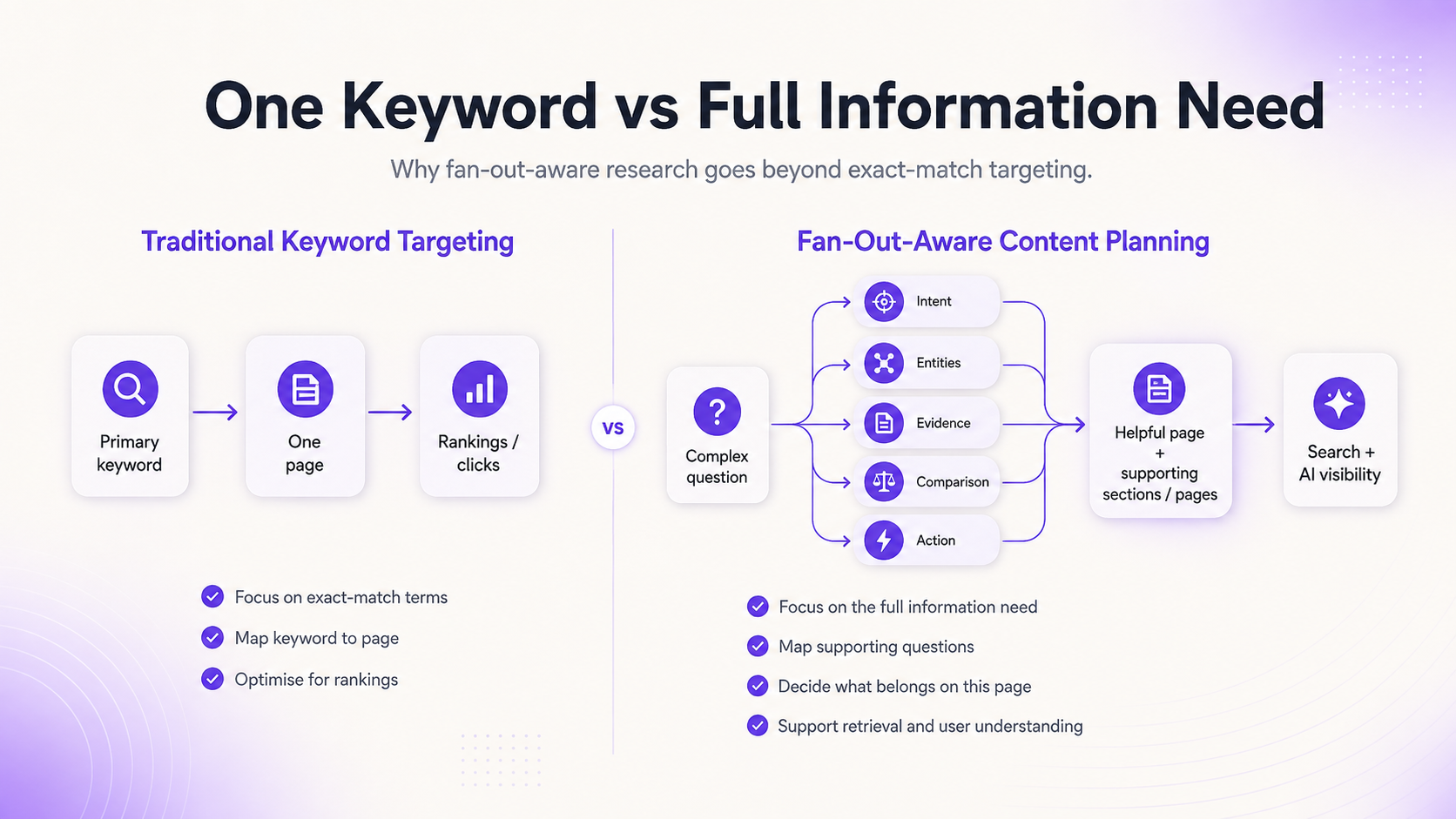
Traditional keyword research often starts with search terms, volumes, competition and intent. Those remain useful because they tell you what people are actively trying to find. A fan-out-aware workflow goes one level deeper: what related information may be required to satisfy that intent completely?
Traditional Keyword Research vs Fan-Out-Aware Research
| Traditional Keyword Research | Fan-Out-Aware Research |
|---|---|
| Starts with a target query | Starts with a target query and underlying decision |
| Studies human search demand | Adds likely supporting information needs |
| Groups close variants | Groups related subtopics and intents |
| Maps keywords to pages | Maps information needs to pages and sections |
| Focuses strongly on ranking opportunities | Also considers retrieval opportunities |
| Often measures query-level rankings | Adds topic/page-level AI visibility signals |
| May create pages from keyword clusters | Creates pages only when an intent deserves its own resource |
1. Start With a Primary Intent, Not a List of Exact-Match Variations
The intent journey is richer than a list of keyword variants. For a topic like technical SEO audit, the reader needs to understand: what it is, what it checks, which issues matter most, what tools are used, what should be fixed first, how often an audit should be performed, how to know the fixes worked, and how it differs from a general SEO audit. That is the level where query fan-out becomes strategically useful.
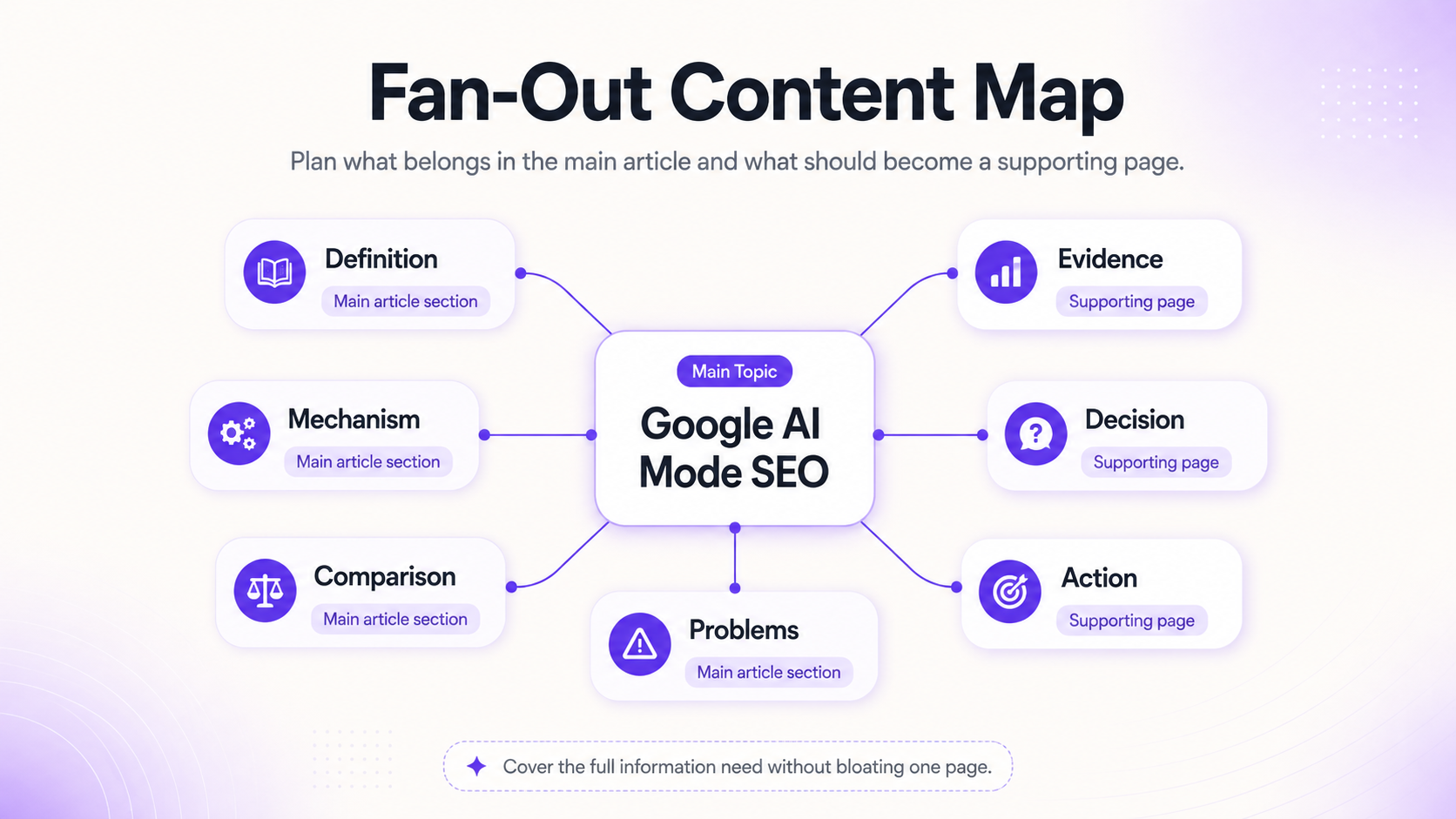
2. Map Query Families Around the Decision
A useful fan-out content map can group supporting needs into families: Definition, Mechanism, Attributes, Problems, Comparison, Evidence, Decision, Action. This is not Google’s published fan-out taxonomy. It is a practical editorial framework for making sure a page answers the questions surrounding the core intent.
3. Separate Human Search Demand From Synthetic Fan-Out Queries
People Also Ask questions, autocomplete suggestions and keyword-tool data are signals about human search behaviour. Fan-out queries are generated by an AI system as part of retrieval. They can overlap, but they are not the same thing. Do not put simulated fan-out queries into a keyword spreadsheet and automatically treat them as searches with established demand. Use them as content-research hypotheses.
4. Decide Whether a Question Belongs on the Same Page
Query fan-out does not mean publishing a separate page for every possible supporting question. Google’s latest generative AI guidance specifically warns against creating separate content for every possible search variation primarily to manipulate rankings or AI responses. A better rule: same intent – usually strengthen the existing page. Distinct intent requiring substantial independent treatment – consider a supporting page.
A Practical Fan-Out Coverage Matrix
Before publishing an important page, review it through a Fan-Out Coverage Matrix. This is an editorial planning framework — not a description of Google’s internal scoring system.
| Coverage Area | Question to Ask |
|---|---|
| Core entity | Is the main subject unmistakably clear? |
| Definition | Can a reader quickly understand what it is? |
| Mechanism | Does the page explain how it works? |
| Important attributes | Does it cover the factors that materially affect the answer? |
| Problems | Does it explain common failure points or misunderstandings? |
| Comparison | Are genuine alternatives or distinctions explained where relevant? |
| Evidence | Are important factual claims supported? |
| Decision | Can the reader understand when the advice applies? |
| Action | Is there a clear practical next step? |
| Supporting pages | Are deeper related topics connected with useful internal links? |
How to Build Content for Google AI Mode
Step 1: Define the Core Question and Entity
Start with the problem the page exists to solve. Write down the main entity, the primary search intent, the desired outcome, the audience, and constraints that materially change the answer. Do this before expanding keyword lists.
Step 2: Map the Natural Follow-Up Questions
Use several evidence sources: keyword research, current SERPs, People Also Ask, related searches, Search Console queries, customer questions, sales conversations, support questions, competitor coverage, and relevant forum or community discussions. Then separate the questions into intent families. Include a question because answering it improves the reader’s understanding or decision — not merely because a tool generated it.
Step 3: Decide What Belongs on This Page
For every related question, choose one of four actions: answer it directly on the current page, mention it briefly and link to a deeper resource, create a separate page because the intent is genuinely distinct, or remove it because it does not help the main reader. This prevents fan-out research from turning into uncontrolled content expansion.
Step 4: Make Important Sections Independently Understandable
A useful section should not need 500 words of previous context before its main answer becomes clear. For question-led headings, use: Direct answer → explanation → evidence/example → nuance → action. That structure helps the reader first. It also makes the information easier for retrieval systems to interpret. But do not mechanically convert every paragraph into artificial “AI chunks.” Google’s current guidance specifically warns against treating content chunking as a special generative AI hack.
Step 5: Add Information That Another Generic Article Cannot Easily Replace
Google’s July 2026 generative AI optimisation guide strongly emphasises valuable, unique, non-commodity content. Useful information gain may include: original data, screenshots, a real audit example, a decision framework, tested methodology, customer research, genuine expert analysis, before-and-after evidence, calculations, limitations, situations where common advice fails, or a transparent case study.
Step 6: Connect Related Entities and Supporting Pages
Internal links should help explain relationships. For example, a Google AI Mode guide should connect to the broader AEO/GEO/SEO framework, AI citations and entity consistency articles, internal linking strategy pages, and technical accessibility resources. That produces something stronger than either one giant page trying to answer everything or dozens of thin pages targeting tiny keyword variations. Your goal is semantic separation with contextual connection.
Step 7: Keep the Technical Foundation Intact
Google says a page must be indexed and eligible to appear in Search with a snippet before it can be eligible as a supporting link in AI Mode or AI Overviews. There is no separate AI Mode indexing process. Check: crawl access, indexability, canonicalisation, meaningful internal links, mobile usability, page experience, important text availability, useful images/video where relevant, and structured data accuracy. The AI layer sits on top of the search foundation.
What Not to Do for Google AI Mode SEO
- Do not chase a fixed number of hidden queries. Google has confirmed query fan-out. It has not published a universal rule saying every query generates exactly eight, eleven, fifteen or any other fixed number of subqueries.
- Do not publish thin pages for every possible fan-out variation. This can create duplicated intent, weak pages, internal competition, poor user experience, crawl waste, and scaled low-value content.
- Do not treat llms.txt as a Google AI Mode requirement. Google says you do not need special machine-readable AI text files to appear in its generative Search features.
- Do not invent special “AI Schema.” Google says there is no special schema.org structured data required for AI Mode or AI Overviews.
- Do not replace SEO with GEO. If Google cannot crawl, index and understand a page, adding new terminology to the strategy will not solve the underlying problem.
- Do not create commodity content at scale. A page that summarises the same information available on fifty other websites gives a search system little reason to treat it as uniquely valuable.
How to Measure Google AI Mode Visibility in 2026
Measurement changed significantly this year. Google launched dedicated Generative AI performance reporting in Search Console in June 2026, and its documentation states that the insights were rolled out worldwide from August 31, 2026. The report includes impressions from AI Overviews and AI Mode. You can analyse visibility using dimensions including pages, countries, devices and dates.
A Practical Measurement Workflow
- Establish the pages receiving AI impressions. Identify which URLs appear within Google’s generative features. Do not assume your highest-ranking traditional pages will always be the same pages receiving AI visibility.
- Compare pages by topic. Look for patterns. Are AI impressions concentrated around definitions, comparisons, product/service information, original research, or detailed guides? This can reveal what types of information Google is currently finding useful from your site.
- Compare countries and devices. For a business serving multiple markets, the country dimension can help show where generative visibility is occurring.
- Watch trends after meaningful content improvements. Track changes after substantial improvements such as adding original evidence, improving missing topic coverage, correcting technical problems, consolidating overlapping pages, or improving internal linking.
Build for the Question Behind the Keyword
The practical lesson from query fan-out is not that keywords have stopped mattering. It is that a keyword is often only the visible entrance to a larger information need.
Good SEO still starts with discovering what people search for. Fan-out-aware SEO then asks: What is the real problem behind that query? Which related questions are necessary to solve it? Which entities need to be clearly connected? Which answers belong on this page? Which deserve supporting pages? What unique evidence can we contribute? Can Google crawl and index the information? Can the reader understand the important answer quickly? Can we measure whether visibility changes?
That creates a more durable strategy than chasing every new AI SEO tactic. For businesses, the goal is still visibility that leads somewhere useful: a better-informed visitor, a qualified enquiry, a product decision or a commercial conversation.
Frequently Asked Questions
What is query fan-out in simple terms?
Query fan-out is when Google’s AI search systems generate multiple related searches from one original query so they can retrieve enough information to build a broader answer. Google documents the technique for AI Mode and AI Overviews.
Is query fan-out the same as People Also Ask?
No. People Also Ask is a visible Google Search feature showing related questions. Query fan-out occurs during AI retrieval and its generated queries are not normally exposed to the searcher.
Can I see the exact fan-out queries Google AI Mode uses?
Not through Google’s current Search Console reporting. The dedicated Generative AI report shows dimensions such as page, country, device and date, but does not document a fan-out-query dimension.
Does Google AI Mode replace traditional SEO?
No. Google states that its generative AI search experiences are rooted in its core Search ranking and quality systems, so crawlability, indexability, helpful content and other SEO fundamentals continue to matter.
Should I create a separate page for every possible fan-out query?
No. Create a separate page when the search intent genuinely deserves independent treatment. Google warns against creating large numbers of pages for query variations primarily to manipulate rankings or AI responses.
Does llms.txt improve visibility in Google AI Mode?
Google says llms.txt is not required and is not used as a special mechanism for appearing in Google Search’s generative AI features.
Is there special schema markup for Google AI Mode?
No special AI Mode schema is required. Google recommends using normal structured data where appropriate and making sure it matches the visible content.
How can I measure AI Mode visibility?
Use the Generative AI performance report in Google Search Console. It reports impressions from AI Mode and AI Overviews and lets you analyse them by page, country, device and date.